
The Long History of Education

Education began in the earliest prehistory, as adults trained the young in the knowledge and skills deemed necessary in their society. In pre-literate societies this was achieved orally and through imitation. Story-telling passed knowledge, values, and skills from one generation to the next. As cultures began to extend their knowledge beyond skills that could be readily learned through imitation, formal education developed. Schools existed in Egypt at the time of the Middle Kingdom.


Matteo Ricci (left) and Xu Guangqi (right) in the Chinese edition of Euclid’s Elements published in 1607
Plato founded the Academy in Athens, the first institution of higher learning in Europe. The city of Alexandria in Egypt, established in 330 BCE, became the successor to Athens as the intellectual cradle of Ancient Greece. There, mathematician Euclid and anatomist Herophilus constructed the great Library of Alexandria and translated the Hebrew Bible into Greek. European civilizations suffered a collapse of literacy and organization following the fall of Rome in AD 476.


In China, Confucius (551-479 BCE), of the State of Lu, was the country’s most influential ancient philosopher, whose educational outlook continues to influence the societies of China and neighbors like Korea, Japan and Vietnam. Confucius gathered disciples and searched in vain for a ruler who would adopt his ideals for good governance, but his Analects were written down by followers and have continued to influence education in East Asia into the modern era.


After the Fall of Rome, the Catholic Church became the sole preserver of literate scholarship in Western Europe. The church established cathedral schools in the Early Middle Ages as centers of advanced education. Some of these establishments ultimately evolved into medieval universities and forebears of many of Europe’s modern universities. During the High Middle Ages, Chartres Cathedral operated the famous and influential Chartres Cathedral School. The medieval universities of Western Christendom were well-integrated across all of Western Europe, encouraged freedom of inquiry, and produced a great variety of fine scholars and natural philosophers, including Thomas Aquinas of the University of Naples, Robert Grosseteste of the University of Oxford, an early expositor of a systematic method of scientific experimentation, and Saint Albert the Great, a pioneer of biological field research. The University of Bologne is considered the oldest continually operating university.


Elsewhere during the Middle Ages, Islamic science and mathematics flourished under the Islamic caliphate which was established across the Middle East, extending from the Iberian Peninsula in the west to the Indus in the east and to the Almoravid Dynasty and Mali Empire in the south.

 

Effective Co-Teaching Strategies

Several collaborative teaching approaches have proven to be successful to guide educators who work together in co-teaching partnerships to differentiate instruction. The approaches include:

  1. Supportive Co-teaching – where the one member of the team takes the lead role and the other member rotates among students to provide support
  2. Parallel Co-teaching – where support personnel and the classroom teacher instruct different heterogeneous groups of students
  3. Complementary Co-teaching – where a member of the co-teaching team does something to supplement or complement the instruction provided by the other member of the team (e.g., models note taking on a transparency, paraphrases the other co-teacher’s statements)
  4. Team Teaching – where the members of the team co-teach along side one another and share responsibility for planning, teaching, and assessing the progress of all students in the class.

Some co-teaching approaches (e.g., complementary and team teaching) require greater commitment to, comfort with, and skill in collaborative planning and role release (i.e., transferring one’s specialized instructional responsibilities over to someone else). It is recommended that collaborative teams select among the co-teaching approaches, as needed, based up the curriculum demands of a unit or lesson and student learning characteristics, needs, and interests.

When deciding which approach to use in a given lesson, the goal always is to improve the educational outcomes of students through the selected co-teaching strategies. Many beginning co-teachers start with supportive teaching and parallel teaching because these approaches involve less structured coordination among the co-teaching team members. As co-teaching skills and relationships strengthen, co-teachers then venture into the complementary teaching and team teaching approaches that require more time, coordination, and knowledge of and trust in one another’s skills.

Does handwriting matter?

Does handwriting matter?

Not very much, according to many educators. The Common Core standards, which have been adopted in most states, call for teaching legible writing, but only in kindergarten and first grade. After that, the emphasis quickly shifts to proficiency on the keyboard.

But psychologists and neuroscientists say it is far too soon to declare handwriting a relic of the past. New evidence suggests that the links between handwriting and broader educational development run deep.

Children not only learn to read more quickly when they first learn to write by hand, but they also remain better able to generate ideas and retain information. In other words, it’s not just what we write that matters — but how.

A 2012 study led by Karin James, a psychologist at Indiana University, lent support to that view. Children who had not yet learned to read and write were presented with a letter or a shape on an index card and asked to reproduce it in one of three ways: trace the image on a page with a dotted outline, draw it on a blank white sheet, or type it on a computer. They were then placed in a brain scanner and shown the image again.

Certificate for Advanced Learners

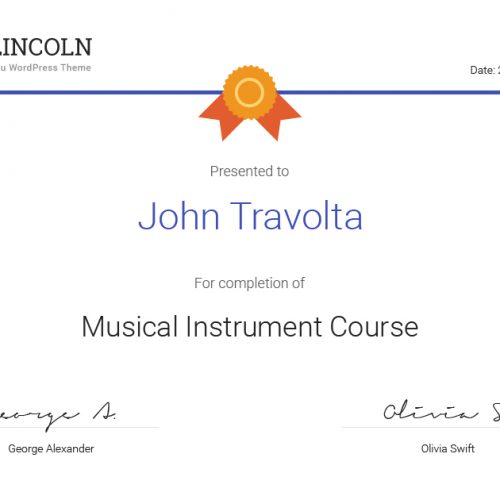
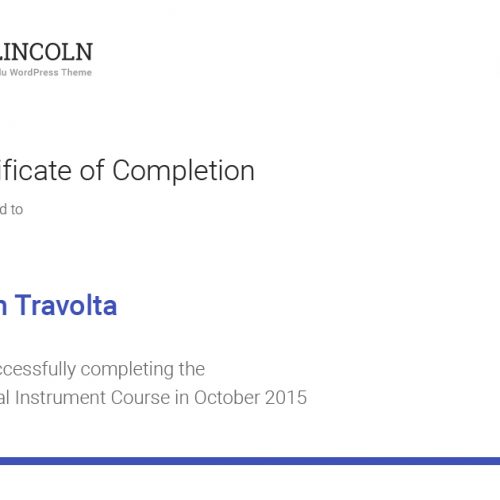
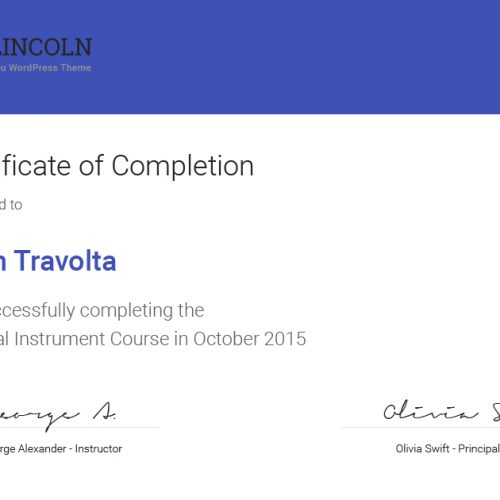
To be able to see this certificate, you need to take and complete one of our course, and print the certificate. It will render all the results to a .PDF file.

The above image is the layout of our certificate for beginners (sample certificate).

If you want to implement the action, Lunartheme gives you a permission to access the dedicated demo account for Lincoln purchasers only. You will be able to test our LearnDash feature with this account right in our main demo.

Detailed account information: (This account is used for testing Course, only admin account can view real certificate)

Username: user

Password: lunartheme


Certificate for Immediate Learners

To be able to see this certificate, you need to take and complete one of our course, and print the certificate. It will render all the results to a .PDF file.

The above image is the layout of our certificate for beginners (sample certificate).

If you want to implement the action, Lunartheme gives you a permission to access the dedicated demo account for Lincoln purchasers only. You will be able to test our LearnDash feature with this account right in our main demo.

Detailed account information: (This account is used for testing Course, only admin account can view real certificate)

Username: user

Password: lunartheme


Certificate for Beginners

To be able to see this certificate, you need to take and complete one of our course, and print the certificate. It will render all the results to a .PDF file.

The above image is the layout of our certificate for beginners (sample certificate).

If you want to implement the action, Lunartheme gives you a permission to access the dedicated demo account for Lincoln purchasers only. You will be able to test our LearnDash feature with this account right in our main demo.

Detailed account information: (This account is used for testing Course, only admin account can view real certificate)

Username: user

Password: lunartheme